EasyFPL
A live expected-points model and transfer planner, scored every gameweek against a baseline.
GW5: average error 1.31 against the baseline's 1.60.
Open EasyFPL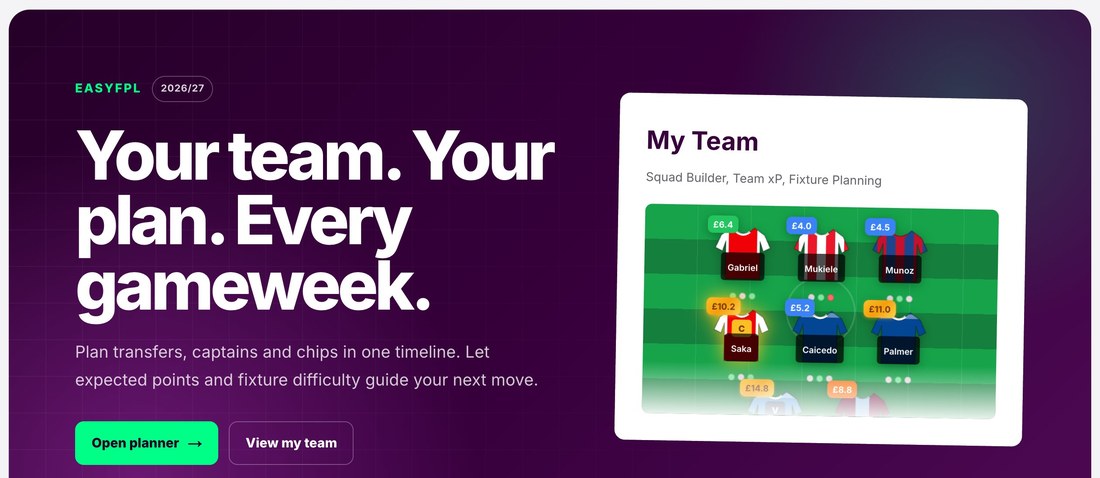
Product engineer · London
I take products from idea to live on my own: the model, the app, the tests and the release.
Explore the workA live expected-points model and transfer planner, scored every gameweek against a baseline.
GW5: average error 1.31 against the baseline's 1.60.
Open EasyFPLChess opening practice with move-by-move feedback.
Beta released behind 610 unit tests, 47 end-to-end tests and 8 production smoke checks.
Try Castled
Coding-plan quota across Codex, Claude and Z.ai, in a Windows tray utility.
Open source under MIT, with explicit freshness and local history.
View source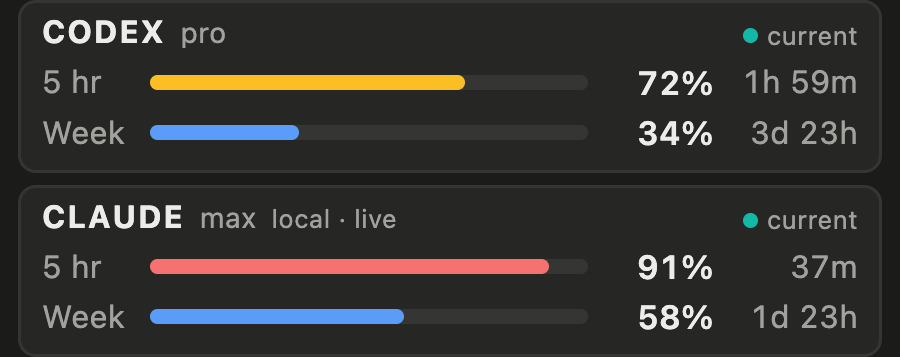
A Fantasy Premier League expected-points model and planner, scored every gameweek against the exact prediction the site published and against a naive baseline. It beats the baseline on RMSE every week and on MAE only from GW4. The harness, the numbers and the limits.
Fantasy Premier League managers decide transfers, captains and chips week to week, under uncertainty about fixtures and minutes. My working thesis is that most free tools show this week's numbers, while a plan across several gameweeks around a chosen Wildcard week is something people would share. That thesis is untested: usage is only now being measured (see "Where it stands").
Every completed 2026-27 gameweek is scored against the exact prediction the site published before the deadline, read back from version control, not a re-run of the model afterwards. The comparison is a deliberately simple baseline: each player's mean points over their last three appearances. Players with no actual row count as zero points and zero minutes.
| GW | Rows | MAE: model / baseline | RMSE: model / baseline | Top-10 recall |
|---|---|---|---|---|
| GW1 | 561 | 1.95 / 1.70 | 2.96 / 3.31 | 0.00 |
| GW2 | 575 | 1.59 / 1.54 | 2.41 / 3.04 | 0.33 |
| GW3 | 553 | 1.58 / 1.56 | 2.41 / 2.74 | 0.00 |
| GW4 | 552 | 1.39 / 1.59 | 2.37 / 2.68 | 0.17 |
| GW5 | 554 | 1.31 / 1.60 | 2.34 / 2.70 | 0.00 |
Rows are player-fixtures scored. MAE is the average points error per player-fixture; RMSE punishes big misses harder. Lower is better for both. Top-10 recall is the share of the actual top-ten scorers (ties at tenth place included) that the model's own top ten contained.
What the table says:
The fixture-difficulty model went through eight rounds of adversarial review by a second model before release. Round 8 ended with a SHIP verdict after an independent 10,000-case seeded sweep with zero failures, plus integrated probes of the save path. The reviewers are models, so they share blind spots. This is process evidence, not an external audit.
The planner takes a team, an optional Wildcard week and any locks (players, chips, transfers, captain), and solves transfers, captaincy and chips through GW19 with a state-graph solver. Across 24 timed solves on Vercel (four teams, every lock type) it took 9 to 15 seconds per solve, replacing a legacy engine that could take over 100 seconds.
It shipped in five increments. Each passed type-check, oracle tests, the full suite, a fresh-reviewer pass and a flag-off byte-identity check, and a single flag rolls back to the old behaviour. At ship (9 Sep 2026) the full suite had six failing tests that predated the planner work: four in the older optimiser and two in UI copy.
The optimality gap is measured on a proxy objective, so I never call a plan optimal. One Wildcard-plus-lock case took 116 seconds because it falls back to the legacy engine.
EasyFPL is live at easyfpl.app (it answered HTTP 200 on 29 Sep 2026). Paid users: 0. Revenue: none recorded. Monthly active users: measuring since 29 Sep 2026. Distribution started late: as of 7 Sep 2026 my own roadmap recorded that no traffic had been driven to the site yet.
The habit I would bring to a customer deployment: score what actually shipped, against a baseline a sceptic would accept, report the weeks it loses, and put a gate in front of every release.
02 / Systems
Live telemetryEngineering telemetry from a market maker I built: how fast it cycles, how often it is up, and how much it handles. Measured live and published as aggregates only.
Loading telemetry…
03 / Notes
No posts published yet.
Future writing will appear here.